 Visions and Nature
 Camargue France | Flamingos
Posted on March 30, 2011
National Reserve Camargue| France
The Reserve, which covers more than 13,000 hectares in the Camargue region, is one of Europe’s largest wetlands reserves.This vast, intact expanse of land, located in the municipalities of Arles and Saintes-Maries-de-la-Mer, benefits from total protection.This unique reserve draws its internationally-renowned heritage from the diversity of its habitats and its native species (in particular the 276 bird species, 258 of which are heritage species) and from its ecological contribution.
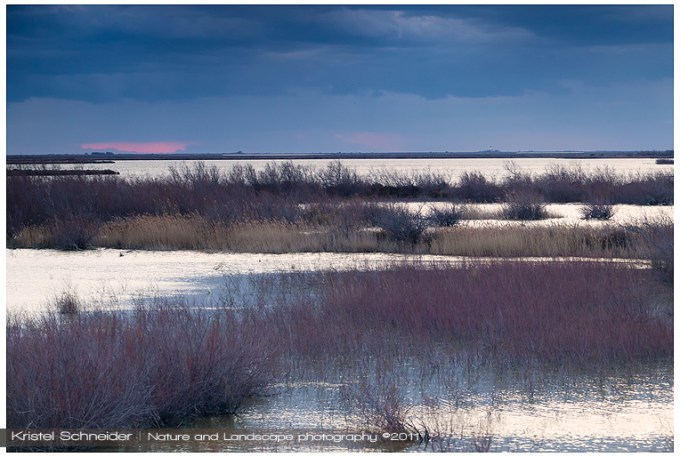
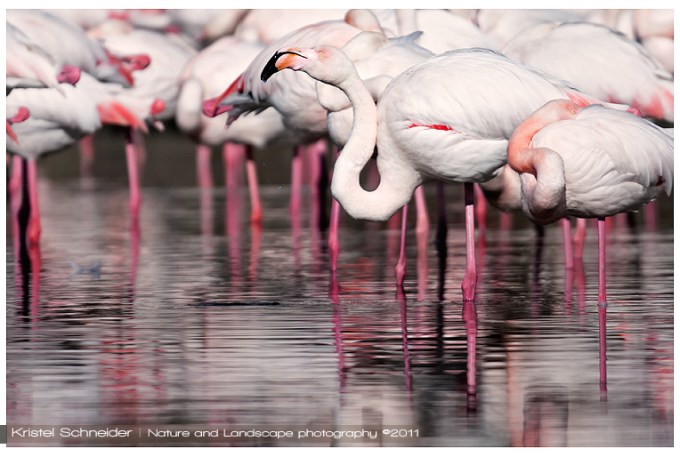
 My trip to the Camargue took place in February 2011 and my photography goal was to shoot some images of flamingos in their natural environment -full colour, silhouettes or just with nice evening light. Unfortunately, I didn’t succeed in all my wishes. Due to the warm weather lots of birds had already moved on to their next destination. So the wetlands were almost empty most of the time .
The old house where we were sleeping was located in the middle of the reserve, surrounded with lakes. A great starting point and for one week I was up before sunrise. While waiting for the sun to rise you could hear the birds wake up and the wind sing. The weather was not great so the light was poor and grey sometimes, that was a shame. Anyhow the experience was great, hear the flamingos call and see the colours change in the landscape.

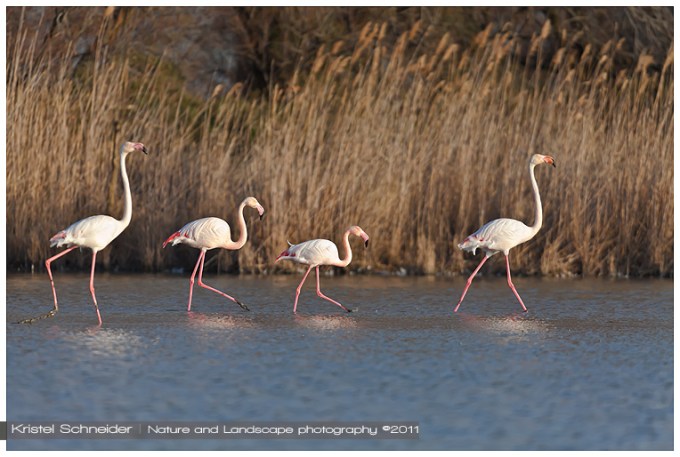
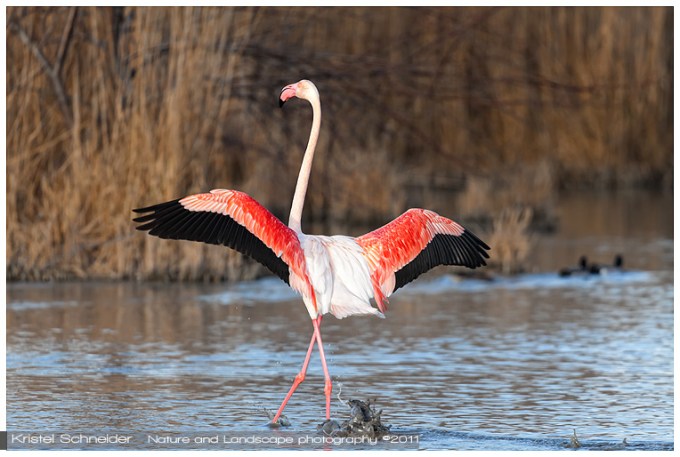 See more images in the gallery : Fauna | Camargue gallery
(Most images taken with 500mm Sigma lens and 40D or 5DMII, polarising filter or ND filters)
Later this week I will post some images from prints and texture on the beach.
Interview with photographer Marsel van Oosten
Posted on March 13, 2011
Visions and Nature
Nature Photographers interviews
Most nature Photographers are obsessed with reality, with nature as it is, with ‘truth’
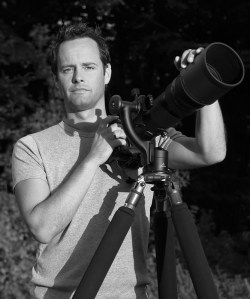
Marsel van Oosten (about)
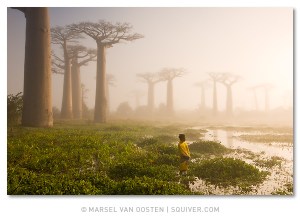
 When I started this item, interviews with nature photographers, Marsel was at the top of my list. I was not introduced to Marsel’s work by one of his nature photos. But one with the title flow: in an old, deserted diamond mining town near the Namibian coast. I had it on my desktop for a long time. I loved its great study of line, shape and texture!
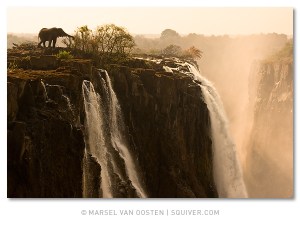
By following his work I noticed that I liked the images which conveyed atmosphere and mood. A great example is his personal favourite: an African elephant standing at the edge of Victoria Falls.
‘Taking photographs began as a way to escape from life in the fast lane. After a trip to Tanzania things started getting more serious, close encountered with the animals of the Serengeti fuelled my passion for wildlife photography.
And five years later I swapped my established advertising career for the precarious life of a nature photographer, a move that demands unyielding devotion ad commitment, Marsel ‘
Who is your inspiration?
My biggest inspiration is a German landscape painter, Caspar David Friedrich (1774-1840).
What made him/her inspire you, with what kind of image(s)?
Friedrich incorporated people as small elements in some of his landscape paintings, giving scale to the image and adding drama. This is what I like to do most with my wildlife photography as well – the animal as a part of a much bigger scene.
What do you like about Nature Photography?
I have worked as art director, and later a creative director, in advertising for over 15 years. I have created myths; worlds of make belief, using images that are far beyond reality. What I like about nature photography is in the first place nature itself, but also the fact that nature can be just as impressive or touching, and often even more, than the fake world that we see on billboards and in commercials every day. In many ways my switch to nature photography is basically an escape to reality. And finally, I like the fact that in nature photography you don’t have full control over your subject, nor over the circumstances. This is often frustrating, but in the end it is what makes me want to try over and over again to get the shot that I have in my head.
Are there things you don’t like about Nature Photography?
Nature photographers can be very fundamentalistic. Most of them are obsessed with reality, with nature as it is, with ‘truth’. They condemn everything that has to do with image manipulation; some even to the extent that removing a piece of grass from the image is considered not done. Photography is an art form, and art is all about freedom of personal expression. The camera is just a tool for the photographer in the same way that a paintbrush is a tool for the painter. Unless you’re shooting for forensic evidence, scientific research or the news, there should be no reason to limit yourself artistically in a way that you’re merely taking photocopies of reality. Nature photography, from a creative point of view, is by far one of the weakest genres. Look at wildlife photographs from two decades ago and compare them to the images that are taken now – the differences are very small. We’re basically still doing the same thing in the same ways; only our cameras and workflow have changed. When you look at fashion photography, nude photography, advertising photography, and even news photography, you see that those genres have changed a lot. There is a reason that art galleries don’t take nature photography, and wildlife photography in particular, serious, and this is it. There is no real creative component in it, it’s all the same. As long as nature photographers keep being more focused on photocopying reality instead of on creating artistic images, our genre will never be seen as art.
Do you have any tips for Visions and Nature readers who would like to become professional nature photographers?
Think again. To earn a living from nature photography is virtually impossible. Contrary to much more commercial photography genres such as fashion and advertising, the subjects in our photography don’t really change. As a result, there is little to no demand for new nature photographs – the market is already saturated. The introduction of digital photography has made this even worse, as so many people are now into photography, and nature photography is probably the easiest genre to get into. Amateur photographers are willing to give their images away for free if they can get published in magazines, resulting in publication prices falling down. Micro-stock, images for as little as $1, are another example of how difficult it is to earn a living from just selling your photographs. There are already millions of photographs of lions, deer, elephants, bears and penguins etc., so demand for new images of the same subjects is extremely low. If you want to become a professional nature photographer, you have to be better and different. A good way to find out if your work is indeed better than the rest is to participate in photo competitions. If your work wins on a regular basis, then your photographs stand out from the crowd. It’s still no guarantee for commercial success, but at least it will help people to notice you. And of course: go out and shoot.
What are your specialities?
I am very fortunate that I’m pretty all-round. Most wildlife photographers are poor landscape photographers and vice versa. I’ve been very successful with my wildlife images, but also with my landscape work, and I’ve published a book with a lot of travel photography. I think that probably has to do with my background in advertising, where I had to do an ad for a car one day, and a commercial for ladies underwear the next.

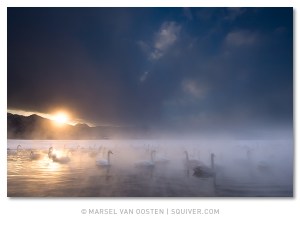
Wildlife photography is my speciality. In my photography composition is crucial, and I go to great lengths to get a clean and graphic look with strong shapes. The habitat is very important for me and I often say that I’m a wildlife photographer that thinks like a landscape photographer.

Share with us one of your personal favourite photographs?
My personal favourite photograph is that of an African elephant standing at the edge of Victoria Falls. For me, this image is the perfect example of what I like to do most; a combination of landscape photography and wildlife photography in a single image.
 Describe how it was taken?
I was visiting Victoria Falls when I was shooting for the Wild Romance book, and I heard from one of the local guides that an elephant had been spotted in the vicinity of the falls. I decided to stay some extra days, hoping to get a shot of the elephant and the falls in one image. I think it was the third day that we saw this particular elephant halfway in the Zambezi River, feeding on the fresh vegetation on one of the many small islets. A few hours later it suddenly walked all the way up to the edge of the falls, and I had to run to the edge myself in order to see as much of the falling water as possible. When I had taken the shot, I knew it was very special. Later I heard from the locals that no one had ever seen an elephant that close to the edge of the falls before.
You are now on Visions and Nature Blog, a Nature and Landscape Photography Blog from Kristel Schneider. Do you know her work?
When you look at her gallery which image pops out for you and why?I didn’t know about Kristel’s work. I had a look at her website and the image that pops out for me is the one of a fly hanging on grass; I like the composition and the lines in the background. I do wish the fly was a bit brighter though. Click here so see the image Marsel selected.
Photo Travel Review Magazine recommended Photo Seminars – Kristel Schneider
Posted on March 3, 2011
 There are hundreds of photo seminars advertised on the Internet, many of which are offered by very well known photographers. Seminars can be very expensive, some of which can cost well above $10,000. What the PTR Team has learned, however, is that sometimes the best opportunities for learning about photography is to find someone who is filled with enthusiasm for photography, whose photographic skills have been recognized by others, and who charges a modest fee to attend their workshops.
Just because a seminar is expensive, does not mean that one will improve one’s skills. There are other more important factors to consider.
One key criterion is whether the workshop leader has the patience to work with someone who knows little about photography and is eager to learn.
It is this latter criterion that the PTR Team can’t emphasize enough. It is of little good to attend a seminar where one feels intimidated by the workshop leader. Or worse, a seminar where the leader spends his or her time shooting for themselves.

Kristel Schneider has developed a reputation for teaching without intimidating as can be gleaned from the comments of her workshop participants:
“Kristel gives you a lot of space to expose your skills without the feeling you are a dummy.” – Dorothé | France
“Had a fantastic day. I arrived not really knowing how to use my camera properly and I left a manual shooter. I left with lots of new skills and I’m really pleased that I followed through on the impulse to join one of Kristel’s workshops.” – Patty | UK
“I am very pleased because it has been extremely worthwhile doing a one-on-one nature workshop. In that way all my questions were answered. Kristel’s enthusiasm, patience has definitely encouraged me. The workshop is excellent value for money and I would recommend it to anybody who would like to improve his skills.” – Ilse |The Netherlands
PTR Team Member Bill Lockhart first became acquainted with the work of Kristel Schneider while serving as a Moderator at NatureScapes.net — he was impressed with her work as a photographer because of her way of capturing the extraordinary from the ordinary. Several of her photographs have been featured as Photos of the Week at the site.
Her offerings are very reasonably priced, … read more on: Photo Travel Review Magazine
Interested in one of Kristel’s workshops click here for an overview.
Visit Kristels website: click on logo

 Visions and Nature