 Visions and Nature
 Interview with Heike Odermatt
Posted on August 18, 2014
Interview series
by Kristel Schneider
‘ …nature photography is just like a book, that no human being can really read …’

I can still remember the first image I saw from Heike, trees in the mist with fresh greens and a line of blue bell flowers. A strong image with great graphical lines and color contrast, this is what you see in all her landscape images. Heike has a great photographic eye. Her graphical translation of a landscape in combination with a good feeling for combining mood and contrast makes her images just ‘ pop-out’ and you hear people say ‘WOW, a real Heike ! “. My personal favorite subjects by her are the landscape details and trees but Heike’s wildlife series are also a lust for the eyes, full with action and emotions. The penguin series she took on the Falklands Islands are real story tellers. For those who do not know Heike Odermatt, I am very happy I can introduce her to you on Visions and Nature. Enjoy and be inspired by her work!


Can you introduce yourself in a few lines, explain your background and how you got introduced to (nature) photography?
I was born and bred in the south of Germany, on the edge of the Bodensee. Beautiful surroundings with a lot of nature, mountain views and a lake on your doorstep. I have always been very visually inclined and have always loved pictures, especially those of animals and nature. As a child I dreamed of being the person behind the camera, making those beautiful pictures of wild animals and stunning landscapes. I had never dared to dream that this would become a reality. My parents couldn’t afford a camera, so I reverted to paper and pencil. My motives were mainly horses, my passion. When I was 16, we made the move to Holland and a new life began. I was no longer surrounded by big nature and I was not used to being in such a crowded place that was so dominated by both people and culture. I lived primarily for my one passion: horses. Whilst being a student, I acquired my first camera. It was however years later that I had the opportunity to emerge myself more into photography. I tried all sorts of different photography, but nature kept calling. I realised that nature was my “thing“ and that it was where I felt at home. In 2002, I seriously started to work in nature photography.
When I look at your images my personal favourite subjects are the trees and the landscape details. Capturing structures and details from a landscape or an intimate scene with one tree is not easy and will be overlooked by many people. You have a graphical background, do you think this helps you translate the landscape scene into an intimate or strong graphical image ? Can you explain how you ‘scan’ a landscape before you select your frame?
My graphic background has nothing to do with my photography. As I already mentioned in my previous answer, I have always really enjoyed looking at pictures. This has probably given me a strong sense of what I do and do not like, what appeals to me and what does not. As a result, I do not take pictures according to the rules and regulations of picture composition, but purely from a gut feeling. There has to be a balance in the picture. I always try to avoid things that disturb me. Graphic lines in nature make a picture “clean and balanced“. The art is to create a balanced picture out of the “chaos” in nature. Often I hear photographer colleagues say “look at her, she is photographing the opposite direction again”. I do not stay focused on just one thing, but try to remain awake to everything that happens around me, so I can capture it.


Every photographer will enter nature in a different way, prepared or unprepared.
When you go out in the field do you already have a combination/subject in mind or do you let yourself get inspired by nature? To capture a kind a mood you need a certain type of weather, what is your favourite weather and why?
I love being surprised by nature. That is why I usually carry a lot of my equipment with me. A large number of people have an idea in their head or the sort of picture they want to capture. I am open to surprises and very often come home with totally different pictures than the ones I set out to take. My favorite seasons are autumn and winter and my favorite weather conditions snow and fog. In my archive you will not find many pictures of sunrises or sunsets, but you will find more pictures that may feel cold, unexpected and surprising. I love experiencing winter and raw nature, and my aim is to get this feeling across in my pictures.


You once said that nature photography is just like a book, that no human being can really read, every time you enter nature it is as if the book gets thicker and thicker ? Can you explain what you mean with this?
Nature is always different, every time you go back somewhere, you find something new. You should never ignore that one beautiful moment with the wonderful light, because you can return to he same spot 100 times and never see that very moment again. Nature is constantly moving, areas change, the climate changes. Fortunately, we will never be able to finish this book, and it will always be fascinating to look for new images. The beauty of this book is that there are no words in it. Nature speaks her own language and those who are open to it will understand it. And that is exactly my style of photography, my pictures tell their own stories and do not need words to tell stories or evoke emotions.

Although I understand it is very personal but I think many of the readers know that you are struggling with your health lately and for this reason you are not able to spend as much time in nature enjoying your camera. Knowing that your main goal is to feel better again I realise that my normal question in the interview series about photography goals and destinations in 2014 and 2015 feels a bit awkward so I just take this opportunity to wish you a fast recovery and hope that you can enjoy your camera soon again !
Many thanks Kristel. My first goal is indeed recovery, so that I can enjoy photography even more in the future than I already had in the past. In 2014 I will still work on my recovery and my first photographic steps will be close to home. People have asked me before why I mostly do my photography so far away from home. My answer has always been: As long as I am capable of traveling to the places close to my heart, I will do so. When I am no longer capable of that, I will find my photographic challenges closer to home. And obviously, that is what is happening now. I do however have still a lot of plans and hope that I will have recovered enough by 2015 to fulfill my dreams of photography in the Arctic, Antarctica and surrounding areas.

© Heike Odermatt
Share with us one of your favorite personal photographs? And tell the story behind it?
In 2002 I visited Iceland for the first time and this was also my first trip purely aimed at nature photography. In 2004 I visited Iceland again, this time with a small group of photographers, still using analog technology. During this trip we hardly had any snow and the temperature was mostly above 0°C . On the way to the Gullfoss waterfall, all we had was rain and as a result, very green surroundings. The more beautiful the Gullfoss presented itself. Due to the water flying up, it was difficult to see across to the other side – the side covered with “cauliflowers”. I took advantage of the few seconds it was visible through the mist of water. Sometimes you make a picture that you think you are going to be really proud of. The picture you cannot wait to see developed. This was one of those pictures. To me, this was the most important picture of this journey, and I could hardly wait until I got the slides of the photo lab back in the hope that this particular roll was not damaged. This picture is now 10 years old, but to me it still signifies all I love: a wintery, fairytale-like image that takes you into another reality.
Do you have any exhibitions or other events coming up?
Until now, I have no exhibitions or events planned, let’s wait and see what 2015 will bring…
Before the interview Heike had a look at Kristel’s website (www.kristelschneiderphotography.com) and picked out images that really popped out for her and she explains why:
The layering and the different stages off he autumn leaf appeal to me.

© Kristel Schneider
An image with a story, focused on the important things. Less is more, like in this picture.

© Kristel Schneider
I really love trees. They all have their own character which becomes very visible in the autumn. The softness of the colours and the structures in these two images are very well done.


© Kristel Schneider
Beautiful, silent, mystical image in all it’s simplicity. The blue in this image intensifies this feeling.

© Kristel Schneider
Coming up next, in the “Interview-Series” : Sandra Bartocha , don’t miss it!
See other interviews here
Interview with Daisy Gilardini
Posted on July 23, 2014
Interview series
by Kristel Schneider
I remember I was moved by some of Diasy Gilardini’s images when I first saw them: two little Polar Bears curled up together, Harp Seal pups with fluffy white fur and breathtaking ‘cold’ landscapes.
Pure emotions and intimacy are the ingredients of Diasy’s work. You can feel her love for the subjects and her special bound with the Polar Regions. Maybe deep in her heart she became the vet she wanted to be, taking care of animals via awareness and fighting for what she believes is right, making people aware of how fragile nature and its habitats are.

‘ I always think of Antarctica as a Planet on our Planet. It looks like everything stopped at the time of creation. Everything is in harmony, pristine and pure.’

Can you introduce yourself in a few lines, explain your background and how you got introduced to (nature) photography? I am a Swiss certified expert in finance and accounting by training but my passion for travel, nature and wildlife made me change my career in 2006. Since then I have been a full-time professional photographer specialized in Polar Regions.
In another interview you said that on your 4th birthday you got a little white seal puppy toy and that you always wanted to see these seals in their own habitats. Can you explain what you felt when your dream came true?
After that first trip you visited the Polar Regions many times. What makes you go back there all the time?
Yes it all started long ago… I was only 4 years old when I received a little stuffed seal puppy toy as a gift from my Godparents. My Mom explained that the seal puppy was coming from a very cold place and that it lived on and under the Polar ice. I was mesmerized by those stories. Thereafter, I dreamed to be able to see them in their natural environment. It took me seven years to be able to save the money for a trip to Antarctica but that trip totally changed my life!
I still remember the first landing on Half Moon Island in the South Shetlands. With a lump in my throat I was shaking with the emotion to be surrounded by hundreds of Chinstrap penguins. That day I could not even take a picture and the few I shot were all blurred because of the shaking… 😉
Many times I tried to understand this irresistible attraction to the Poles, which I would define almost as an addiction or an obsession. These extreme adventures transport me out of my ordinary worldliness and lead me to discover my own primitive instincts. By returning to the foundation of existence, I feel comfortable by simply following the rhythm of nature, which inspires deep respect and awareness for the importance of these delicate wild areas. I always think of Antarctica as a Planet on our Planet. It looks like everything stopped at the time of creation. Everything is in harmony, pristine and pure.
Being in the moment, cut off from the hysteria and drama of our “modern” society, connecting with Mother Nature and feeling the oneness of the universe is what brings me back there year after year.


When I look at your images I get moved and I can almost feel the emotion you must have felt at the moment when you pressed the shutter button. I read that in the Polar Regions the animals are not afraid of humans so it is easier to approach them. But they are still wild animals. What do you do to make the animals feel comfortable with you so that you can capture such emotions ? Your landscape images are magical and pure. I can imagine you need a lot of research and preparations for your trips. When you are at your location do you let nature speak by itself on the images or do you have certain scenes in your mind beforehand already ?
There is a huge difference in shooting wildlife in the Arctic compared to Antarctica. Up north the animals have been and still are hunted by the local communities, while in Antarctica animals don’t have any predators on land.
Penguins are extremely curious animals : if you sit down to their level and keep quiet they will often approach to check you out. You obviously would not like to have a polar bear approach you to check out his next meal!
I usually do not pre-visualize the images and simply let Nature speak to me: Be in the moment!
However, in the field and before an assignment I apply my five “golden rules”
- BE THERE
It sounds stupid but if you are not there you won’t be able to get the picture. This means that you have to do your homework in order to always know where the best spot is, and what the best time of the day is. I am on location ready to shoot usually one hour before sunrise and I stay one hour after sunset. In the middle of the day, when the light is harsh and the animals are less active, I either work on my images or have a nap and rest for the next shoot. - KNOW YOUR SUBJECT AND YOUR EQUIPMENT
In wildlife photography it is essential to know your subject in order to be able to anticipate behaviour and catch the magic moment. The perfect knowledge of your equipment will allow you to be fast enough to freeze the action with the right camera settings. - PASSION
The love and passion you will put into your photography will shine through your images. - PATIENCE
In wildlife photography there is a lot of frustration involved. You can spend hours and hours and even days and/or weeks, at the mercy of the most challenging weather conditions without getting the shot you are looking for. Patience is simply essential. - PERSEVERANCE
Never give up! At the end you will succeed… if you are patient enough!

Wildlife photography and ethics do not always go hand and hand together.
People fake wildlife scenes to get the perfect picture or go to faraway places to take photos of animals in captivity or attract them to special feeding places. What are the limits for a photographer? Photocontests ban images that were taken in captivity, do you think the same must be done for images taken on ‘feeding places’ ?
I am a member of the International League of Conservation Photographer (iLCP).
The mission of the league is to further environmental and cultural conservation through ethical photography. Awe-inspiring photography is a powerful force for the environment, especially when paired with the collaboration of scientists and decision makers. As environmental photographers it is our duty to capture the beauty of places at risk and spread a message trough our images.
Nowadays wildlife and nature photography is an extremely competitive field where the word ethics sometimes (too often) get lost.
Ethical is an adjective describing something related to moral principles and we all know that those vary a lot depending on culture and locations.
Personally I put my ethics in front of everything and easily give up a shoot if I think is inappropriate.
No captive animals and/or baiting ever come into consideration in my work.


What are your photography goals, destinations for 2014/2015 and what would you like to achieve ?
I am currently working on a presentation/exhibit/book on the North America’s bears and the issues they are facing due to loss of habitat, pollution, climate change and hunting; I hope to start touring with it by spring 2015.
Meanwhile I am constantly working on the Polar Region project and will be spending some time in the Arctic in the summer and November/December down South.
Can you share with us one of your favorite personal photographs? And tell the story behind it?
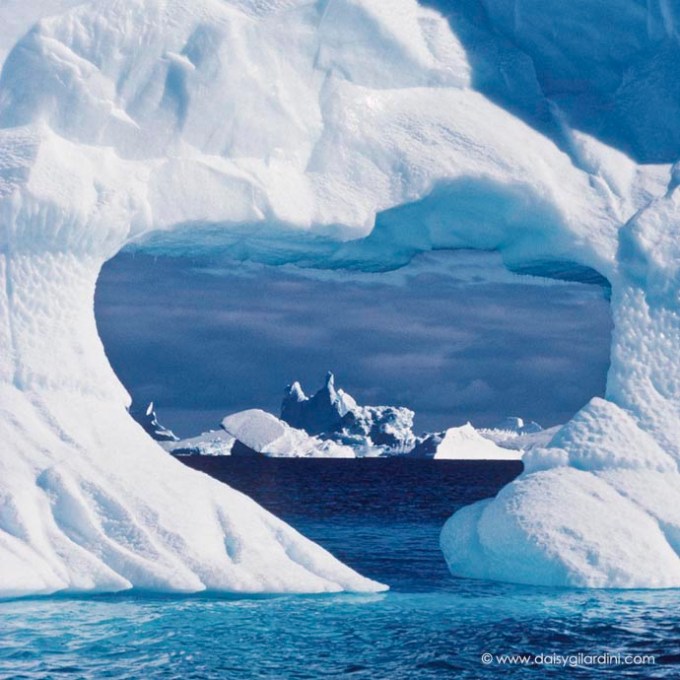
One of my favorite images represents a heart-shaped iceberg shot during my first trip to Antarctica back in 1996. It really perfectly symbolizes my love for this marvelous white continent.
It feels like during my first trip there I left a piece of my heart down South and now, every year, I have to go back to check on it.
Do you have any exhibitions or other events coming up?
The first few months of 2014 were really busy with talks and exhibits in Canada and Europe. I will dedicate the second half of the year working on my Polar project and new Bear show.
Before the interview Daisy had a look at Kristel’s website (www.kristelschneiderphotography.com) and picked out images that really popped out for her and she explains why:
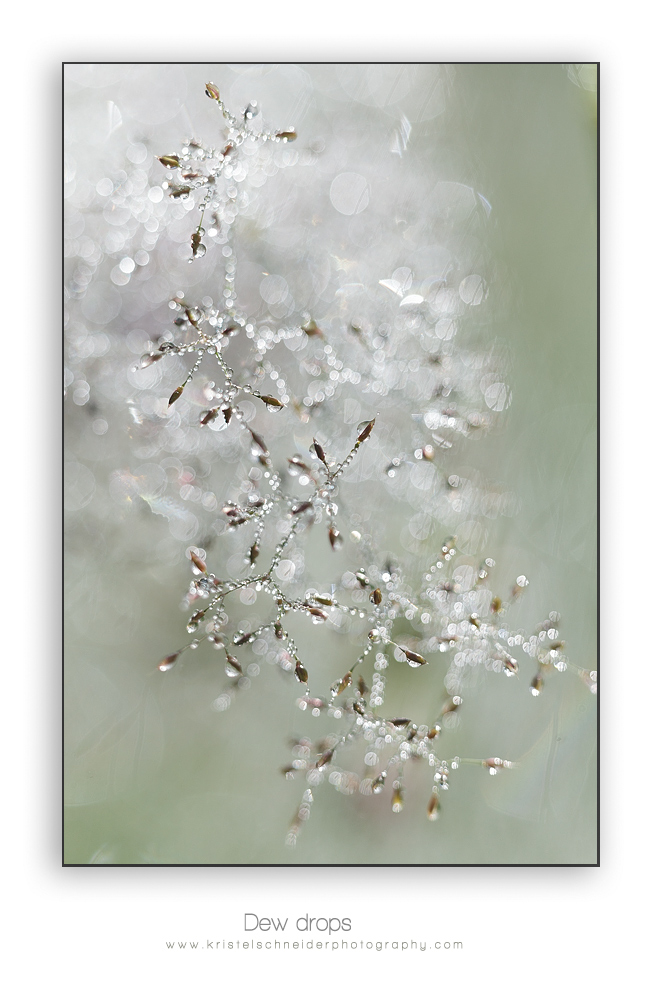
I love the intimacy of Kristel’s macro photographs. In particular “Dew drops” is an explosion of light, sparkle and joy.
A treat for the viewer’s eye.


Coming up next, in the “Interview-Series” : Heike Odermatt, don’t miss it!
See other interviews here
Interview with Misja Smits
Posted on June 24, 2014
Interview series
by Kristel Schneider
‘I like to surprise myself to avoid getting bored with my own pictures’

Misja Smits
I am not sure anymore where I saw Misja’s work for the first time, in Dutch magazine Grasduinen (now Roots) or via the Argus photocontest, but I can still remember I was totally stunned by the color impact of her images. In my opinion Misja is one of the best close-up photographers in the Netherlands. The way she positions the tiny mushrooms, flowers and other subjects in the frames in combination of the natural color pallets is just fantastic. For those who do not know Misja Smits, I am very happy to introduce her to you on Visions and Nature. Enjoy and be inspired by her work!
Can you introduce yourself in a few lines, explain your background and how you got introduced to (nature) photography?
I was born in a little rural village (Liessel) in the Netherlands. After my secondary school I moved to the city of Nijmegen, where I still live so far. Photography has always been part of my life but it’s since 1993 when I started the study Photographic Design in the Hague that it really became important for me. After this study I started working as an employee in a photo store where nowadays photo finishing is my main task. Since 2002, when I met my boyfriend Edwin Giesbers, who is a professional nature photographer, I focused entirely on nature photography. During the last years I have shifted my attention more and more to macro subjects, such as toadstools, flowers and insects. I guess you can call me a semi professional photographer, because I always have had my job in the photo store and until now I have no plans to make my money completely from photography. It is my hobby, I have to admit it is a pretty persistent hobby, but I like it this way. The fact that I can do my own thing, without any pressure from outside, is one of the thing I like most about it. It gives me a kind of freedom in which I can develop myself in my own way and in which I can enjoy photography the most.
What originally triggered your interest in the ‘Small World’ and what fascinated you the most in these subjects ?
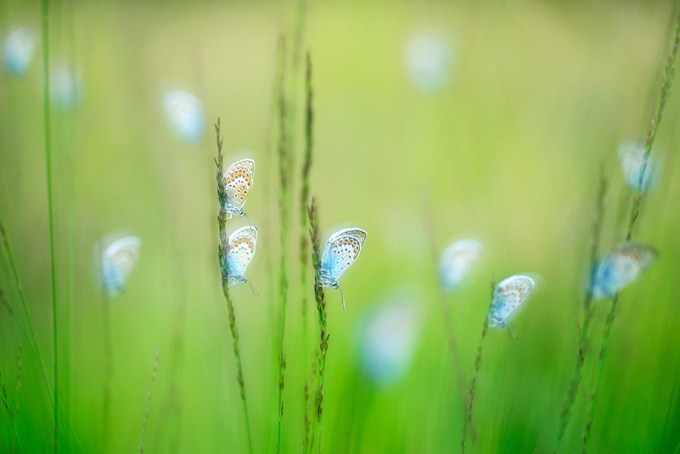
I guess what triggered me the most was the surprising effect of the macro lens. Of course there was also the interest in the tiny insects, flowers and toadstools and surely I loved to be out there all by myself or with my boyfriend to experience nature and its silence. However it was the thrill of the final image that attracted me the most. The macro lens was the perfect lens for me to create my own image, an image that could not be seen with the naked eye but only by looking through the macro lens. It gave me endless opportunities to play with sharpness versus un-sharpness, light versus shadow and to create my own color palettes.
© Misja Smits


When I look at your images I get a happy feeling, the way you put the subjects, color combinations in the frame are always in good harmony.
The color contrasts are well chosen in combination with a well balanced background and the depth of field. The ‘small world’ can sometimes even look smaller or bigger depending on the positioning of your subjects. When you go out in the field do you already have a combination/subject in mind or do you let yourself get inspired by nature? Do you use natural light in you photography or other tools ?
Thank you for your compliments!
All the things you mention like the placing of my subjects, the framing, the use of colors, the use of fore and background, are indeed very important for me. The subject is not just the main thing, it is always the entire picture that counts for me. This means hard work in the field, because my desired image almost never comes easy. Sometimes it also means quitting a certain subject, even after spending lots of time on it, because the entire picture just won’t do it for me in the end.
In the beginning I used to go into the fields without any idea or subject in mind. I just went ‘open minded’ and just ran against my subjects. This worked out perfectly for me until a few years ago. Then somehow I wanted more or something else and maybe I wasn’t satisfied with the images any more once I got home. Nowadays I go out more and more with a certain subject (plant or insect) in mind. This approach requires more research in advance. Most of the information (where the insect or the plant live, when the best season is to visit it, what the best time of the day is to approach it) I can get online and from colleague photographers. And then, when I am out in the field with my ‘wanted’ subject I let myself be inspired by nature and its environment to complete the total picture.
Very occasionally I not only have a certain subject in mind, but also a certain image. This is however a tricky approach, because when it works out fine everything is ok. But on the other hand if it doesn’t work out as I wanted it to it’s difficult to shift my attention to the idea of getting inspired by nature again.
It’s funny to see this transformation in my approach over the last years. By answering you I realize it. The thing is I never really made these choices consciously. Somehow I just follow my heart without thinking too much about why I do certain things.
Most of the time I use natural light. I like sunny conditions, in which I keep my subject in the shade (in necessary with a white/light grey umbrella) and play with the fore and background that are (partly) lit by the sun. Sometimes, such is the case with tiny subjects such as hair moss or toadstools that are positioned low on the ground, I use a flashlight to put my subject in the spotlights. This is mostly the case in the evening or on cloudy dark days during low light situations.

© Misja Smits
In another interview I read that you like to keep surprising yourself and others. Can you explain in what way and why and if you think you manage to do so ?
I like to surprise myself to avoid getting bored with my own pictures. I like to surprise and challenge myself visually. This sometimes means taking a photo of a subject that I haven’t photographed before, but it can also mean approaching my subject in a way I didn’t do before. With a different approach I mean using a different technique or playing with a different fore and background, or by placing my subject much smaller or bigger in the frame. Actually anything that makes my images different than the ones I shot before. These differences can be very small or even invisible to an outsider but for me they can make the difference between a good and a lesser image of myself. I have succeeded when I experience the ‘wow’ effect. I am convinced I need to have these surprising ‘wow’ effects to grow in my photography and to not stand still.
What are your photography goals, destinations for 2014/2015 and what would you like to achieve ?
This may sound implausible, but apart from trying to challenge myself and hoping to be able to enjoy nature photography together with my boyfriend for as long as I live, I have no further photographic goals or destinations. Of course I do am very happy with all kind of things that cross my path, such as exhibitions, publications, selling pictures, winning awards and so on, but these are not my main goals. My main goal is very clear: to be able to enjoy nature photography.
Share with us one of your favorite personal photographs? And tell the story behind it?
This is a difficult one… But I have chosen for my picture called ‘Bride and Groom’.

Bride and groom – © Misja Smits
I made this picture of two Edelweiss specimens in 2011 in The Hohe Tauern, a National Park in Austria. Two years before I was in Liechtenstein and I searched like crazy for these flowers. Unfortunately I couldn’t find them and now, in the Alps in Austria, I just bumped into them without really looking for them.
There’s something special about the Edelweiss. Once this alpine plant nearly was extinct. This was because of tourists gathered the plant, or because of locals used the plant as a medicine for stomach pain.Therefore, nowadays the plant is protected and can be found more easily.
In the early morning the flowers caught the first sunlight. I was extremely happy with the dewdrops that were left after a rainy night. The surrounding grass, which was covered with dew drops, was the perfect ‘decor’ for the two plants which were standing so tenderly next to each other. The background was colored in blue because it was still in the shadow. Somehow the two plants reminded me of a bride and groom. To emphasize the dreamy effect I used double exposure. Double exposure is a function in my Nikon body where the camera automatically merges two exposures which are made one after each other. During the first exposure I have focused on the two Edelweiss plants, while during the second one I have un-focused my subject by focusing a little bit more close to the lens, all without moving the camera.
Do you have any exhibitions or other events coming up?
In fact I do have an exhibition coming up, knowing in the Moormuseum in Geeste, Germany. The director had visited my exhibition in Stapelfeld earlier this year and has invited me for a future exhibition in his museum during the opening season next year. I am very happy to know that my 41 images will have a new destination to show off soon.
Furthermore soon a portfolio of my macro images will be published in a French magazine. I am very excited about this because it’s my first French publication. More information about these future projects will follow as soon as possible. Stay tuned for the last updates by following me on my Facebook and website.
Before the interview Misja had a look at Kristel’s website (www.kristelschneiderphotography.com) and picked out images that really popped out for her and she explains why:
I like Kristel’s graphic pictures of the trees in winter. Somehow you manage to capture the essence: graphic lines/forms and a winter feeling.

© Kristel Schneider
I think this picture is strong because of the oblique lines that draw the attention from the left bottom part to the right upper part of the picture. The abstract lines and forms of the vegetation are perfectly framed and contribute to an abstract character of the picture. The white color of the snow and the brown/red color of the vegetation are the only ones and give a certain balance to the picture.

© Kristel Schneider
Lovely creative play of sharp versus un-sharp, showing a strong picture doesn’t necessary have to be sharp. This photo stands out for me because of the daring to un-focus on the main subject and by doing so making the form of the flamingo even stronger. Then there is the great DOF created by the water reflections, which contributes to a pleasing fore and background. And the choice for black and white (which may be a natural effect of the silhouette conditions or may be transformed in post processing) seems to be the only right one. Great picture with great vision!

© Kristel Schneider
I see lots of pictures with this moving effect coming by but only few of them have the ‘wow’ effect on me. This one surely has it. The moving effect alone won’t do it. Here everything comes together in the right way: the form of the tree-trunk comes out great, the colors of the green leaves and the colors of the red/brown soil go very well together because they contrast. Also by the creative effect the light on the tree trunk and its roots is emphasized in a positive way. I like to see an experimental picture and surely when it pleases the eye!
Coming up next, in the “Interview-Series” : Daisy Gilardini, don’t miss it!
See other interviews here
Interview with Andrea Gulickx
Posted on May 25, 2014
Interview series
by Kristel Schneider
©Trui Alink
For me, creativity flows best when I go into nature with an open mind. No planning at all.
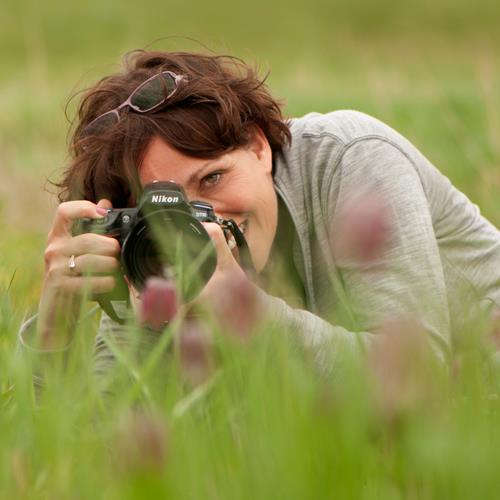
Light, passion and creativity are three elements Andrea combines in her beautiful photography art work.
Thanks to Facebook I got introduced to this creative Dutch photographer, one of the good things about social media,
you can get connected to new talented people.
After reading more about Andrea I think I can add a fourth element, words.
Next to photography she likes to combine words with images, her weekly quotes are very much appreciated on her Facebook page.

Can you introduce yourself in a few lines explaining your background and how you got introduced to (nature) photography?
As a child I liked to stroll through nature. One day my dad gave me his old analogue SLR camera which made me very happy. As a family we would often go to the mountains on holiday and I always took the camera with me. We walked a lot and during these long walks I always took pictures of nature in all its variety. I think that’s when my love for nature and photography started. Unfortunately, this camera didn’t live very long. At the age of twenty I started in the fashion industry, where I designed graphic prints for children’s clothing. For work I had to travel to Asia and in Europe and during these visits a small compact camera was always in my bag. During photography trips I also did fashion styling for the company brochures of different brands I had worked for. Fashion photography doesn’t suit me, but I can still remember the beautiful places we explored and the wonderful light situations. After a number of years working for a boss I decided to become a freelancer because I had the need for freedom. During this period I met my partner for whom photography is also a hobby. On our first holiday I took photos every now and then with his SLR camera. Then from that moment it started to itch again. I had missed that viewfinder and the use of different lenses. The next holiday I had my own digital SLR camera. My passion for macro photography started in our garden. I am a self-taught photographer and I learned by experimenting. After the first experiments, I left the garden and went into nature again to discover more. And up till know I am still discovering.
Last year you made the big step to become a full time photographer, a step a lot of people would dream of but not dare to take, can you tell us what made you decide to follow your dream and about the biggest challenges you had to face.
I am an intuitive person and I take most decisions with the heart. I do not think or analyze that much, I just do if it feels good to me. I did the same when I decided to start as a freelance designer. One day I came to work and felt that this wasn’t an inspiring setting any longer. Before I knew it I was in the office of my boss and I told him I was going to quit. Just like that. When something feels so strong I have to follow my intuition. Of course I had my doubts afterwards but that was only my head because in my heart I knew that I had made the right choice. And it was the right decision since my own business was doing very well for many years. When I restarted with the photography in 2006 I instantly felt this would be very important to me in the near future. The only question was how and when? It primarily remained a hobby beside my job as a graphic designer. Three years ago I came up with the idea of teaching workshops. But I immediately put the idea aside as a result of a lack of faith. I thought “What do I have to offer, I am not doing anything special…?”
I didn’t follow a course or study in photography, so who am I to think that I can teach workshops? To have faith in myself was my biggest challenge. Although I knew that photography would be my next challenge, I also knew that I was not ready yet. Just like many other things my photography came right out of my heart, based on feeling or emotion and “technique” meant nothing to me. I knew exactly what I did for myself, but to make it clear to other people is totally different. I have used two extra years to grow into my own photography, to create my own recognizable style and to find a way to share it with others in a way that suits me. The overwhelming enthusiastic comments and wonderful results after the first workshops gave me the confidence to move forward and to take the next step: to stop as a freelance graphic designer. Of course this was a big step and it is not possible yet to live just on photography but with the support of my partner and his confidence in me I am sure I will manage. I am convinced that as long as you follow your heart and if you have faith in what you you succeed in the end.


The subjects and compositions of your images are often ‘dreamy’. By playing with depth of field and natural light you created your personal style. Can you explain how you built up your images, do you go with the flow and let the subject decide your composition or do you prepare your images beforehand by knowing your subject and surrounding?
For me, creativity flows best when I go into nature with an open mind. No planning at all. I have tried it once, but that worked counter productively. It totally blocks me and as soon as I let it go, creativity is there again. I am not a person who goes for ‘innovative’ pictures either. I just want to enjoy and take photos which make me happy. When I look through my camera I feel a strong bond with nature and everything goes naturally. I can sit down somewhere spontaneously and from that moment I just look through the camera and start exploring. By photographing that way my flow rises and the pictures appear by themselves. Sometimes it seems as if nature takes me by the hand and shows me its beauty. For me the most important element in my pictures is “the light”. Eight years ago I read in a photo magazine that you could learn a lot “by reading the light in pictures”. I really had no clue what they were talking about. However this sentence always stayed on my mind and now I understand and underline the importance. Light is always challenging.
‘An image says more than words’ . Moreover you like to combine images and words in one frame.
Can you tell us the thoughts behind this ?
I always had a weak-spot for text and I think that might be caused by my graphic background. The combination of text and image has always been fascinating to me. Text and image can reinforce each-other. Although to my opinion an images should speak for itself, I sometimes have a feeling the picture is out of balance or is missing something. Text then can make it more complete. In addition, I love quotes. I like to set people thinking on certain topics. The quotes are not mine but I find them on the internet. I am a spiritual person but I like to keep both feet very firmly on the ground. Spirituality has brought me a lot in particularly in creating my self-image and defining how I want to live. Photography has also taught me more about myself and it has changed me at a certain stage. It gave inner peace, and it brought me closer to myself.
What are your personal photography goals for 2014 and what would you like to achieve in photography in the long term? Do you have any exhibitions or other events coming up ?
Of course, I hope the workshops will continue to be as successful as they are at the moment. I am very happy the way things work out now. I love to share my passion and knowledge with people. In addition, I still have some wishes like my own book for example. I have already made a good start but it’s on hold because not all the pictures are there to complete the book so as to to tell the story. So, that’s still work in progress. Exhibitions will also continue although nothing has been planned for the coming month. This season I am invited by two photography clubs to give a lecture. This is a new development for me and I am really excited. I also would love to bring people closer to nature and photography. Using my knowledge, my images and with music as an additional dimension. I have an idea, but this has to evolve too. I see that as ‘my’ future music.


Can you share some of your personal photographs you like best?
And can tell us about the conditions and your emotions when you captured this image?
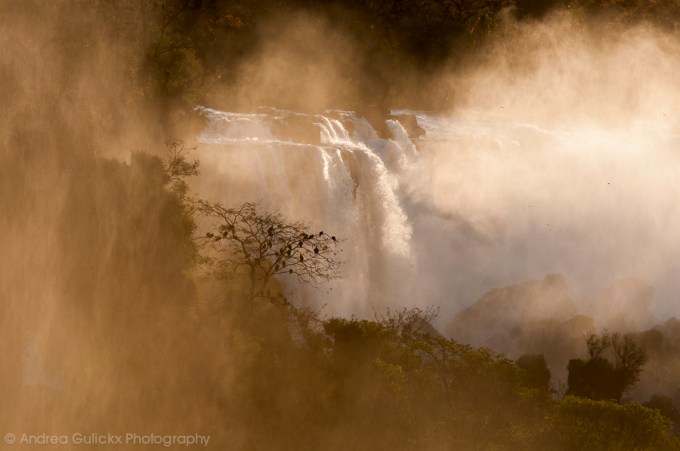
Perhaps it might be a bit strange but when asking for my favorite picture I will not come up with a macro-photo. Probably because I have made so many and this kind of photography is so me. Landscape photography, however, is more challenging for me and if I finally manage to make a good picture it makes me intensely happy. This picture was made during our holiday in Brazil, at the waterfalls of Iguaçu. Facing the Victoria Falls a couple of years ago I thought there couldn’t be a more beautiful place than that but I was wrong. The Iguaçu falls are overwhelming. We stayed at the park so we could make use of the very first light till the very last. That is what we have done for two full days. It’s very special to see how the same location changes during the day just by the movement of the sun. The light at sunset had my preference and I was fascinated by the glowing water and the birds. The light and the atmosphere also in this type of photography remain the most important for me and both were there, through the mist and the evening sun. In this case I made use of a tripod which I never use for my macro photography. I have also used a Lee filter. I have made a whole series of pictures but this one is certainly my favorite.
Andrea had a look at Kristel’s website (www.kristelschneiderphotography.com) and picked out some images that really popped out for her.
She explains why:

(c) Kristel Schneider
1. My favorite picture from Kristel is this one. As much as I love light, I also have a weak spot for darkness in pictures. I think you made a perfect balance of those two in this shot. The composition is very strong. The small delicate drop is beautiful in the ‘spotlight’. It really touches me with its serenity and loneliness.
2. I love it out of focus in a picture. You still can see what kind of birds they are. Beautiful to see how you used your creativity to make your own perception of it. The light on the water surface is beautiful.
3. In this delicate picture I really love how you have used the light. The softness all around brings your eyes right to the subject. The way the two flowers are reaching out to the light…just like they are telling their own story. Beautiful and sensitive.
4. Just Beautiful. The movement and colours, I love it. Strong composition. Sometimes you don’t need to say more you just have to look and enjoy.


Coming up next, in the “Interview-Series” : Misja Smits, don’t miss it!
See other interviews here
Fresh greens – wind and rain
Posted on May 12, 2014
Spring 2014
Fresh green leaves by
Kristel Schneider
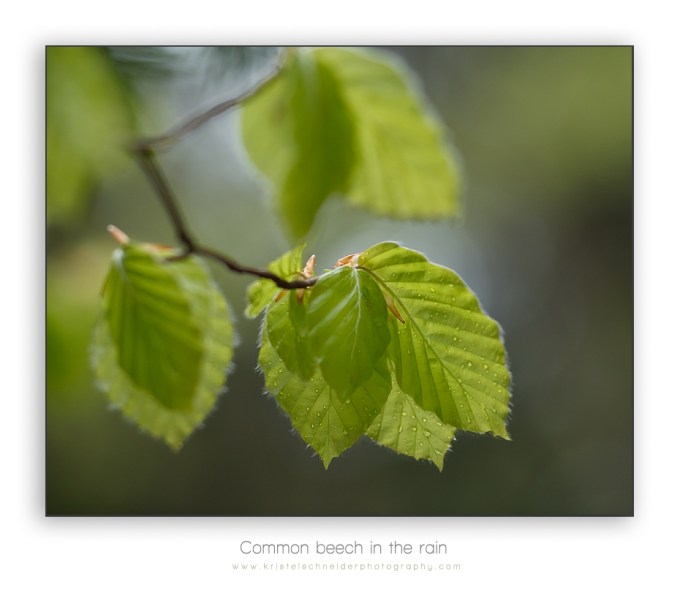
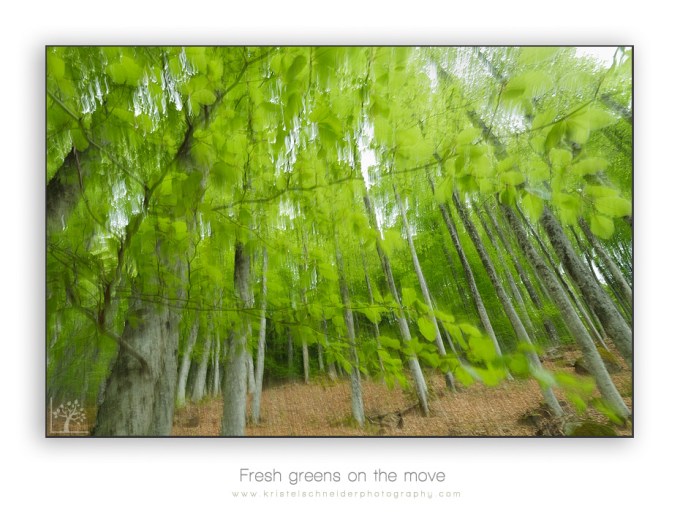
Yesterday afternoon I drove up into the mountains (Monts du Forez), the trees are still with fresh green colors from the young leaves.
I was happy with the weather, yeah I know….wind and rain ;-), but I prefer a day with overcast weather, to get more color contrast.
In my camera bag I had two lenses, my Canon 17-40mm and a ‘new’ old lens, Meyer-Optik Görlitz Primotar 3.5/180.
My tripod stayed in the car, with the wind I like to play with manual focus and sometimes shake the camera.


Visit Kristels website: click on logo

 Visions and Nature